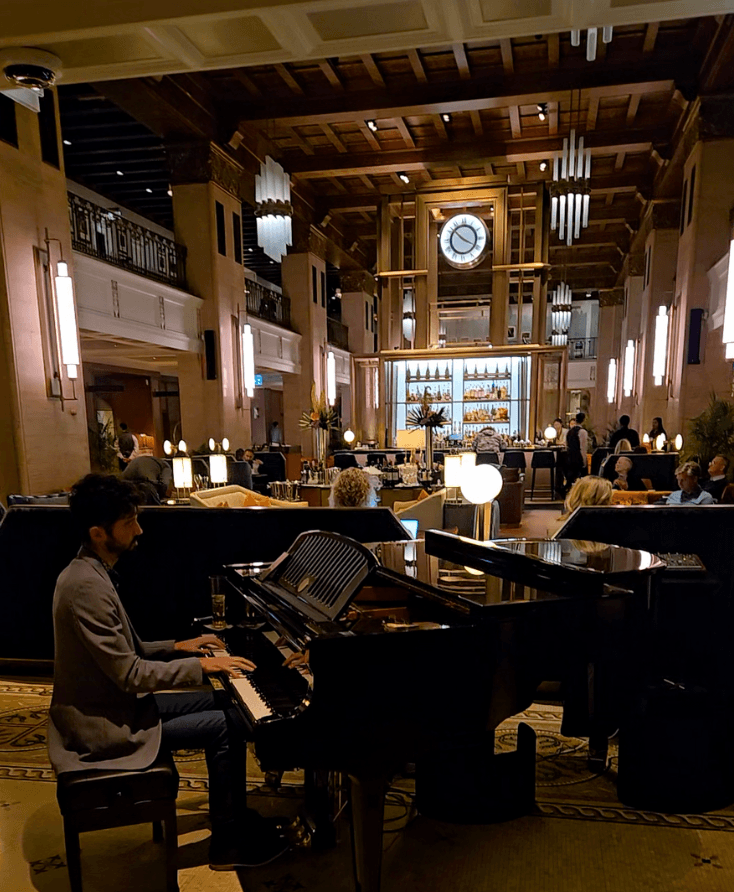
Finding Library Bar requires a kind of commitment the Fairmont Royal York doesn't explicitly warn you about. The hotel's lobby is expansive and full of beautiful rooms, each presenting itself with the quiet confidence of a correct destination. We walked through a lounge with coffered ceilings, a corridor bar with deep wood and banquettes that nearly convinced us, before finally spotting the discreet sign and the paneled wall that turned out to be the actual entrance.
Our hostess seemed entirely unsurprised. We'd done what everyone does. The room runs smaller than the approach suggests, intimate rather than grand, with a fireplace anchoring one wall and afternoon light settling across velvet upholstery and book spines in a way that makes everything look like it's been there a long time and it has.
She led us to two green armchairs beneath the portrait of George Locke, Toronto's chief librarian in 1929, who had been personally invited to hand-select the books for the hotel's original reading room. His portrait watches from above the mantelpiece with the expression of someone who knows exactly where everything is.
The shelves still hold that original collection, some volumes in better condition than others. The room has the acoustic quality of a place designed to absorb rather than amplify, quieter than you'd expect given how close it sits to the lobby and how full the tables were.
We had spent the morning at the Art Gallery of Ontario, moving through the galleries at the particular pace paintings impose: the kind that makes you realize an hour has passed before you know it. The AGO left us pleasantly recalibrated, slightly loose in the joints.
By the time we settled into the armchairs at Library Bar, the shift in tempo felt almost physical. The fireplace was going. Outside, across Front Street, Union Station moved people through its Great Hall with purpose. In here, things were quieter, and the servers moved between tables with unhurried competence.
Library Bar has been named among North America's 50 Best Bars. Once you're seated, that fact becomes easy to forget, because the room doesn't behave like one that keeps score. The cocktail menu, overseen by Director of Beverage James Grant, is organized not by base spirit but by literary chapter: Outlaws, Explorers, Masterpieces, Auteurs, Martinis, Classics. It's a conceit, but it earns itself, you browse differently when the categories are moods rather than ingredients.
Each cocktail comes with its source material and a brief note on the concept; reading through the chapters takes longer than most drinks lists, and that's clearly the point. Grant runs what amounts to an ongoing development program behind the menu: a cocktail laboratory in the hotel, working through infusions, botanical extractions, new house liqueurs, ideas that get tested and adjusted and tested again before they reach guests. The drinks taste like the result of that kind of attention.
My first was The Man in Black, Johnnie Walker Black, mezcal, amburana grappa, dry vermouth, and a collection of bitters in four flavors, inspired by Stephen King's Dark Tower series.
I'll admit the name influenced the order, which is the kind of thing you don't usually disclose in a drinks piece. It arrived dark and serious, in a rocks glass with no ice, which seemed right for a drink that wanted no dilution. The mezcal smoke is the opening line; everything else comes later and more quietly: dried fruit, a flash of pepper, something sweetly unidentifiable that appears and fades.
Fifth Business was the better drink in my opinion, named for Robertson Davies' 1970 novel, it's built on Dillon's rye with pear, raspberry, maple, rosemary, and Fernet-Branca. Davies coined "fifth business" from theatrical tradition: the character who is neither hero nor villain nor love interest but whose presence makes everything else work. Essential without being central. The cocktail holds that quality. The maple could easily have dominated, but here it stays in proportion. The Fernet adds structure without lecturing. The rye runs through the whole thing without declaring itself. Each ingredient is doing its job, none of them competing, and the drink becomes more interesting the longer you sit with it.
We worked through two rounds each over the better part of two hours. Somewhere in the second hour, Chef Brian Tang's menu became a test of character we nearly failed. His kitchen draws on Ontario farms and East Coast fisheries, a Tuscan kale and ricotta cappellacci in porcini cream, East Coast oysters, a prime rib sandwich with tobacco onions and horseradish aioli, a 12-ounce striploin with rhubarb beetroot ketchup and Madeira jus. The menu has the same sensibility as the room: a bit classic, a bit current, nothing trying too hard. We had an honest conversation about whether we were actually hungry or just reluctant to leave. It was the latter.
The Connoisseurship Roadshow has moved through Ontario long enough that certain patterns have become familiar, and one of them is this: the places worth returning to are almost always the ones where somebody cared enough to get every detail right and then left you alone to enjoy it.
Library Bar is one of those places. The room that afternoon held travelers with luggage still stacked by their chairs, people reading alone in corners, business conversations at low volume, what appeared to be a first date going reasonably well. None of them seemed out of place, and part of that is practical, the tables sit far enough apart that privacy is assumed rather than negotiated, and part of it is something harder to name, a quality the room has had long enough that it's become structural. We're going back. Next time we're ordering dinner.